Nine times out of ten it is the oil, not the pan. Every fat has a temperature at which it starts to break down and smoke, and cast iron is very good at exceeding it. The University of Illinois Extension defines smoke point as the temperature at which a fat begins to smoke, puts most cooking oils between about 350°F and 450°F, and says high-heat work wants oils rated 400°F or above. A preheated cast iron skillet clears 400°F easily. Put butter or an unrefined flavourful oil into it and you have a smoking pan within seconds — nothing is wrong, you have simply paired a low-smoke-point fat with a high-heat pan.
Below are the four causes in the order they actually occur, with the test that distinguishes each. The useful thing to understand first is that smoke is not a malfunction signal: it is the same chemistry that creates seasoning in the first place. Oil only polymerizes into a hard layer when it is taken past its smoke point — which is why Lodge’s own seasoning method bakes a thin coat at 450 to 500°F, and why a seasoning session that produces no smoke has probably not worked.
Cause 1: the fat’s smoke point is below the pan’s temperature
What it looks like: smoke starts within seconds of the oil hitting the pan, before any food goes in, and it keeps going.
The test:what did you put in? Butter, extra-virgin olive oil and most unrefined or cold-pressed oils sit at the low end of the 350–450°F band. Refined high-heat oils sit at the top of it.
The fix:for searing, use a refined oil rated 400°F or above and add the flavourful fat at the end, off the heat. Grapeseed is a sensible default — it is the oil Stargazer names in its own care guide and the one Smithey pre-seasons its pans with at the factory. One honesty note: none of the oil listings we link publishes a smoke point, so we are working from the Extension’s published band rather than from a bottle, and we are not going to print a per-oil number we cannot cite. The whole field is ranked in best oil to season cast iron.
Cause 2: there is more oil on the pan than you realise
What it looks like: the pan smokes while heating up, before you have added any fat at all, and the smoke has a slightly acrid edge.
The test: wipe the cold pan with a paper towel. If it comes away oily, you have your answer. This is the single most common self-inflicted cause, and it comes from the storage coat: you wiped oil on after the last wash and left it visibly wet.
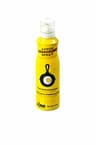
The fix:Lodge’s own instruction is the one everybody skips — rub a light layer of oil on, then wipe the surface until no oil residue remains. The pan should look dry, not glossy. A pump spray makes this easier than a hand and a paper towel do, because it lays down a thinner film to start with. The same excess, left to cure at a low temperature instead of burning off, is what produces a tacky pan — covered in why is my cast iron sticky.
Cause 3: old buildup burning off
What it looks like: thick, dirty smoke from an older pan, often coming off the outside walls and the underside rather than the cooking surface. Frequently worse the first time you take a hand-me-down pan to a high temperature.
The test:look at the pan’s exterior in good light. If there are thick, uneven, slightly glossy black deposits — not the even matte surface of good seasoning — that is carbonised fat from years of cooking, and it has a lower combustion threshold than you might think.
The fix:mechanical, not thermal. Scrape the loose material off, then scrub with chainmail or a stiff brush until nothing more transfers to a paper towel, then re-season. Lodge reduces its own routine to “wash, dry, and rub with oil” and sells scrapers and a chainmail pad for exactly this. Our black residue guide separates buildup from flaking seasoning, which look identical and need different treatment, and how to restore cast iron covers the full strip if the pan is genuinely encrusted.
Cause 4: an empty pan on high heat
What it looks like: you put a dry skillet on the biggest burner on full, walked away, and came back to a smoking pan.
The test:was there food in it? An empty pan has nothing absorbing the energy you are pouring in, so it climbs far higher and far faster than a loaded one, and the thin seasoning film on it passes its smoke point. Lodge describes heat capacity as a material’s ability to retain energy and cast iron as particularly adept at it — which cuts both ways.
The fix:preheat for 3 to 5 minutes on medium-low, as Lodge instructs, and only then turn it up. This also matters because repeatedly overheating a dry pan is the one scenario where smoke really does cost you something: America’s Test Kitchen’s account of the chemistry describes how too much heat depolymerizes the layer, and the American Chemical Society’s explainer describes the same bonded-polymer structure being undone. You are not damaging the iron. You are removing the seasoning you built.
The case where smoke is the point
One more scenario, because it panics people the first time: you are re-seasoning in the oven and the kitchen fills with smoke. That is the process working. Polymerization — oil crosslinking into a hard, plastic-like layer bonded to the metal — happens abovethe oil’s smoke point, which is why Lodge specifies a thin coat baked at 450 to 500°F for an hour, a temperature above the smoke point of every oil in the Extension’s band.
So: ventilate, do it when nobody is trying to eat, and judge it by quantity. Steady smoke for the first stretch of the bake is normal. Billowing smoke and oil pooling or dripping means too much oil went on, and the result will be a sticky, uneven layer rather than a hard one. Thin coats, every time — the full method is in how to season a cast iron skillet.