How we ranked these
Four criteria, in the order that actually decides whether a set is worth buying. Notice that none of them is “how many pieces.”
1. Would you have bought every piece separately?
This is the whole test, and almost every bad set fails it on one specific item. A box with a 10.25-inch skillet, a griddle and a lidded pot is three different capabilities. A box with a 6.5-inch skillet, a novelty cornstick pan and a trivet is one capability and two things that will live at the back of a cupboard. The pieces are usually cheap to make and expensive to store, which is why they end up in sets rather than on shelves.
Applied here, that rules out a lot. It is why the top pick is three plain skillets rather than a bigger box: 8, 10.25 and 12 inch are the three sizes a household actually reaches for, and we argue that case size by size in our cast iron skillet sizes guide. It is also why a set that includes a ridged grill pan gets a caveat rather than a bonus point: a grill pan is a real tool, but it is the hardest piece of cast iron to keep seasoned, because the valleys between the ridges are awkward to wipe and awkward to scrub.
2. The set-versus-singles arithmetic
A set is only a deal if it beats the sum of its parts on the day you buy it, and in cast iron that is genuinely a coin flip rather than a formality. Lodge discounts individual skillets hard and often, and it runs dozens of different bundles at the same time — its own set catalog currently lists everything from a skillet-and-accessories pairing to a Blacklock collection costing more than most people’s entire cookware budget. Two boxes with almost the same contents can carry very different prices in the same week.
So do this before you buy, and it takes about a minute: open the set, open the individual listing for each piece in it, and add them up. If the set does not win, buy the one piece you actually need now. The live prices in the table above update daily and are the right place to start that check; we deliberately do not print a price in a sentence, because a number written into prose is stale the week after it is written.
3. What the piece count is really counting
Piece counts in this category are close to meaningless, and the honest versions still surprise people. Lodge’s own 5-piece set is four pieces of cookware and one lid — the lid is counted separately. Its 7-piece Essential set is three pans plus a hot handle holder, a pot holder and two pan scrapers. Neither is dishonest, and both are perfectly reasonable boxes; but if you compare a “7-piece” against a “3-piece” on the number alone, you will conclude something false.
The rule that survives: count the cooking surfaces, then count the lids, then ignore everything else. Accessories are worth having and cost very little separately. A set whose piece count is inflated by silicone is not a scam, but it is not the bargain the front of the box implies.
4. Weight, storage and the sink
Cast iron sets arrive as one very heavy delivery, and the published set weights make that concrete. The three-skillet box is a listed 17.35 lb. Lodge publishes 28.0 lb for the 5-piece set and 16.91 lb for the Essential pan set. That is not a criticism of the iron — the weight is the point of the material, and it is exactly why these pans sear the way they do — but it is a real constraint on a small kitchen.
Three skillets do not stack neatly, a two-burner griddle does not fit in a standard sink, and a 5-quart dutch oven wants a shelf of its own. Before you buy a set, look at where all of it is going to live and how you are going to wash the biggest piece in it. This is the most common reason a set gets regretted, and it has nothing to do with the cookware being bad.
The arithmetic on the two Lodge sets, in public
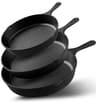
We already list most of these pieces individually, so the sums are easy to show rather than assert. The three-skillet set is an 8-inch, a 10.25-inch and a 12-inch classic, published at 3.2 lb, 5.36 lb and 7.89 lb respectively — 16.45 lb of pans against a listed 17.35 lb for the box, which is about as close as published figures ever get.
The 5-piece set is where the numbers get more interesting. Its four cooking pieces are the 8-inch skillet (3.2 lb), the 10.25-inch skillet (5.36 lb), the 10.5-inch round griddle (4.51 lb) and the 5-quart dutch oven (11.64 lb), which totals 24.71 lb against Lodge’s published 28.0 lb for the set. We are not going to pretend to know exactly where the remaining pounds sit — the individual dutch oven figure and the set figure may count the lid differently, and Lodge does not publish a lid weight on its own. Both numbers are published; we print both rather than reconciling them with a guess.
Bare or enameled?
Almost every set in this category is bare iron, and there is a practical reason for that: enamel is expensive per piece, so an enameled set gets costly fast, and enameled pieces are bulkier because most of them come with their own lid. The stackable set on this list is the exception that solves the second problem, by giving three pieces one shared lid — clever, and also the reason you can only cover one of them at a time.
The finish decision should be made on how you cook, not on what happens to be bundled. Bare iron is the right answer for searing and for anything dry and hot; enamel is the right answer for acidic food, long braises and not wanting to think about seasoning. We lay out the whole trade in enameled vs bare cast iron, and if you are leaning toward enamel, the individual pots in our budget enameled dutch oven roundup publish considerably more about themselves than any enameled set we could find.
One thing worth knowing before you buy enamel in a box: bare iron has no meaningful upper oven-temperature limit, but every piece of enameled cast iron carries one, and the knob is usually the limiting part rather than the pot. The numbers, and why they decide whether a pot can bake bread, are in enameled cast iron oven-safe temperatures.
The two-piece “sets” nobody calls sets
The best-value multi-piece cast iron purchases are usually not sold in the set aisle at all. A combo cooker is a shallow dutch oven plus a skillet that doubles as its lid — two pieces, one price, and the shallow shape makes loading a sourdough loaf far easier than a deep pot. A double dutch oven does the same trick in the other direction, pairing a 5-quart pot with a shallow lid that works as a standalone pan.
If your reason for wanting a set is “I want more than one thing,” look at those first. Our combo cooker review goes through what it does and does not replace, and it is the piece we recommend most often to people who think they want a boxed set.
What we would not buy
- Any set built around a novelty piece. Cornstick pans, decorative skillets and mini servers are fine things to want on purpose — we rank the useful molded bakeware in our cornbread pan roundup — but as the makeweight in a set they are how a box gets to a bigger number.
- A set of nested small skillets as your only cookware. A 6, 8 and 10-inch trio is easy to store and genuinely cheap, and it is also three pans that cannot sear dinner for four. Crowded food steams instead of browning; the physics of that is in our steak skillet roundup.
- Any set that publishes nothing. If the maker will not state a weight, a country of manufacture or a warranty, that is a finding rather than a gap in your research. Cast iron is a category where a lifetime warranty costs the manufacturer almost nothing, so declining to offer one is informative.
- A set bought to save money on a single pan. If the piece you actually want is the 10.25-inch skillet, buy the 10.25-inch skillet. It is the cheapest item in the whole category and the one we recommend to nearly everyone in our main skillet roundup.
How to check a set in about a minute
Read the contents list, not the piece count. Every reputable maker publishes exactly what is in the box. Lodge sells two nearly identical Essential sets that differ by one pan — one has a grill pan, the other an 8-inch skillet — at the same list price, which is a perfect illustration of why the number on the front tells you nothing.
Add up the singles. One minute, four browser tabs. If the set does not clearly win, it is not a set worth buying.
Check the biggest piece against your kitchen. Your oven rack, your sink, your cupboard, and your wrists. A 12-inch skillet is 7.89 lb empty, and a full 5-quart dutch oven is a two-handed lift.
Assume every bare piece needs the same care. A set does not arrive maintenance-free because it came in one box. Everything bare in it wants the same thin-oil-and-heat routine, which we walk through in how to season a cast iron skillet, and the same wash-and-dry habit from how to clean a cast iron skillet.
Buy for the kitchen you have. Sets are bought optimistically and used realistically. The piece you will use five times a week is almost certainly the 10.25-inch skillet; everything else in the box is a bet on a future version of your cooking. Make that bet deliberately, with a lidded pot or a griddle, rather than accidentally, with a fourth skillet size.