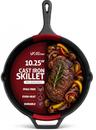
Why ten inches is the right default
This site already ranks the small pans at 5 to 8 inches and the large pans at 12 to 15, and the middle is where most purchases actually land, for four reasons that have nothing to do with brand.
It matches a domestic burner.A 10 to 10.25-inch pan sits over a standard gas or radiant element without overhanging it, which means the rim gets roughly the same heat as the center. A 12-inch pan on a normal hob has a cool outer ring, and on a radiant glass top the makers have a view about overhang — GE publishes a one-inch-maximum rule, which our glass top guide works through.
It is a one-handed pan. Between 4.5 and 5.4 lb for the conventional picks here, against 7.89 lb for a 12-inch Lodge. That is the line between a pan you shake and tilt and a pan you lift with two mitts.
It is the size recipes assume.Lodge’s own cornbread guide gives the 10.25-inch a specific yield and a 20 to 25-minute bake, and almost every skillet recipe written for a household of two to four is written around this diameter. A 12-inch pan bakes a thinner cornbread and an 8-inch bakes a thicker one; neither is wrong, but you are adjusting.
It fits an oven and a sink. Unlike the 15-inch, which is 22.2 inches long overall and beats a lot of both.
How we ranked these
We own no units and run no tests, so nothing here is a hands-on verdict. The ranking is published specification plus buyer fit, in this order: the published flat cooking surface where a maker states one, the published weight, the finish (sand-cast or machined), the handle, and what the warranty actually says. Where a maker and a listing disagree we print the maker’s number and name both — Lodge publishes 10.25 lb for the covered deep skillet where its listing says 8 lb, and that is a two-pound gap you would want to know about before you lift it out of an oven.
Where a published figure is not credible we publish nothing. The Utopia listing’s 4.85 lb sits next to a stated length of 5 inches for a 10.25-inch round pan, and with no maker spec page anywhere to settle it, we leave the weight blank rather than repeat a number we cannot stand behind. That is the same decision recorded in our Utopia Kitchen review.
The cooking-surface problem
Almost nobody in cast iron publishes the flat floor, which is the only figure that tells you how many chicken thighs fit without touching. Among the pans here, three makers do:
Stargazer: 8.1 inches inside a 10.5-inch rim.That is a 2.4-inch gap, because the pan has generously flared walls and a drip-free rim instead of pour spouts. It is the smallest usable floor per inch of rim on this page, and it is a deliberate design choice rather than a fault — the flare is what makes the pan easy to get a spatula into.
Field: about 8.75 inches inside 10.25. The best ratio here, and it is the strongest practical argument for the price: more usable floor than the Stargazer in a smaller, lighter pan.
Lodge covered deep skillet: 7.5 inches inside 10.25. The deep walls have to start somewhere, and they start earlier. You trade floor area for three inches of height and a lid.
Lodge publishes no flat-floor figure for the classic 10.25-inch or for the Baker’s Skillet, and Victoria and Utopia publish none either. The cards say “Not published”, which is the honest answer rather than an estimate — and the gap is one of the reasons we keep stating it on every roundup.
Does the machined surface justify the money?
A machined pan is the same iron with its cooking surface milled flat after casting, which the American makers do and the budget brands do not. The honest case for it: it is slick on day one rather than after six months of cooking, it is easier to clean, and it is lighter at the same diameter because a milled pan can be cast thinner without a rough floor to hide. Stargazer’s 10.5-inch is 5.2 lb; Field’s No. 8 is 4.5 lb; the Lodge is 5.36 lb.
The honest case against: a Lodge with two years of use on it releases eggs just as well, both pans sear identically, and you are spending six to eight times the money for the first six months of convenience plus an object you like looking at. That is a real reason to buy one — we are not pretending otherwise — it is just not a performance reason. The whole category is ranked in best smooth cast iron skillets, and the two-way comparison is in Field vs Stargazer.
10 or 10.25? And what about 10.5?
Nothing. These are the same pan for every practical purpose, and the variation comes from where each maker measures — some across the top rim, some across the outside edge. Lodge calls its pan 10.25 inches, Victoria calls its 10, Stargazer calls its 10.5, and all three cook the same two chops. Do not pay a premium for a quarter-inch of stated diameter; pay attention to the flat floor and the weight, which are the figures that differ for real.
Where the number does matter is lids and accessories. A 10.25-inch Lodge lid fits Lodge’s 10.25-inch pans and is not guaranteed to fit a Victoria or a Stargazer, and a handle holder sized for a Lodge handle will not necessarily sit on a longer one. Buy accessories from the same maker as the pan, or measure first.
If you only buy one
Buy the Lodge Classic 10.25-inch. It is the default for a reason, and at this size the reason is arithmetic rather than loyalty: no other pan here offers more usable cooking for the money, and the ones that are better are better by margins most cooks will never notice. Spend the difference on a bottle of seasoning oil and a chainmail scrubber.
Buy the Stargazer 10.5-inch instead if you have cooked on cast iron for years, you know the pebbled Lodge surface bothers you, and you want an American-made pan with a published cooking-surface figure and a warranty that does not expire. That is a narrow case, and if you are in it you already knew.