What the first $50 buys, and what the second $50 buys
This is the only question a hundred-dollar ceiling actually asks, so it is worth answering before the pans. Cast iron is the rare category where the cheap end is not a compromise — it is the mainstream. Under $50 you can already buy an American-cast, pre-seasoned, lifetime-warranted skillet in any diameter from 8 to 15 inches. Our under-$50 roundup ranks that band on its own terms, and the honest summary is that nothing is missing from it except three things.
The second fifty dollars buys exactly those three: a thinner casting, a lid, and enamel. That is the whole list. It does not buy a machined-smooth cooking floor — the cheapest genuinely milled pan in our registry sits well above this ceiling, and the class is ranked in best smooth cast iron skillets. It does not buy a published flat-floor measurement, which almost nobody in cast iron discloses at any price. And it does not buy better searing, because the behavior of a hot iron pan does not improve with price.
1. A thinner casting, which is the one real upgrade
Weight is the thing people actually return cast iron over, and it is the one complaint money fixes inside this band. Lodge publishes 6.14 lb for the Blacklock 12-inch against 7.89 lb for the Classic 12-inch — same diameter, same Tennessee foundry, same Made Right lifetime warranty, roughly 22% less pan to lift. Lodge calls it triple-seasoned, gives it an extended raised handle, and its own page clears it for any stovetop including induction, plus oven, grill and campfire.
Two honest caveats. The Amazon listing for the Blacklock publishes a lighter figure than Lodge does — 5.6 lb against the maker’s 6.14 lb — and we record the maker’s, because a foundry knows what it cast. And less iron means less stored heat: a thin 12-inch pan recovers more slowly after a cold steak hits it than a thick one, which is the trade you are buying. If weight is your actual problem, read best lightweight cast iron skillets first; it ranks the whole registry on published pounds and makes the case that buying a smaller pan is a cheaper fix than buying a thinner one. The full line, size by size, is in our Blacklock review.
2. A lid, which changes what the pan can cook
A classic skillet has roughly two inches of wall and no lid. The Lodge Covered Deep Skillet has 3.43 inches of wall, holds five quarts and comes with a cast iron lid, and that combination does things a skillet cannot: braise, shallow-fry a whole cut-up chicken without oil climbing the sides, hold a stew. It is also 14.49 lb with the lid on, nearly double the Classic 12-inch, and its flat floor is smaller— Lodge draws 8.75 inches inside a 12-inch rim, against 9.12 inches for the classic 12-inch. Deep pans trade cooking area for wall height. The whole class, lidded and unlidded, is in our deep skillet and chicken fryer roundup.
3. Enamel, which is a different pan rather than a better one
An enameled skillet has glass fused to the iron. You never season it, and you can cook tomato, wine and citrus in it for hours without a metallic taste. In exchange you cannot build your own non-stick layer, you can chip the coating, and you have to respect an oven ceiling that bare iron does not have. Under $100 there is exactly one enameled skillet in our registry worth listing — the Tramontina Bestow 10-inch, a published 5.73 lb with a lifetime warranty on the listing — and it is roughly a fifth of what the French pans cost. Tramontina publishes no oven temperature for this skillet (it publishes 450°F for its 6.5-quart pot), so that row on its card reads “Not published” rather than borrowing the pot’s number. If enamel is what you want properly, the full category is in best enameled cast iron skillets.
How we ranked these
We own no units and run no lab, so nothing here is a hands-on verdict. What this page ranks is published specification plus buyer fit: the maker’s own weight and dimension figures where they exist, the listing’s where they do not, and a note on the card whenever the two disagree. Where a figure is not credible we publish nothing rather than repeat it.
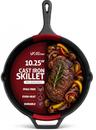
The budget pick is the clearest example of that policy, and it is worth reading before you buy it. The Utopia Kitchen 10.25-inch is a genuinely cheap, genuinely cast iron pan, sold on Amazon by Utopia’s own storefront rather than by a marketplace reseller. But its listing publishes a 5-inch length beside a 10.25-inch width, which cannot describe a round pan, and there is no maker specification page anywhere to settle it — so we leave its weight blank and say why, at length, in our Utopia Kitchen review. Buy it to save three dollars over the Lodge if three dollars matters. Buy the Lodge if a published warranty, a named foundry and a weight you can trust matter more, which for most people they should.
The band itself is the other half of the ranking. A pan appears here only if the live price layer showed it under $100 on the date stamped above, and that layer is the only place any number on this site comes from. If the daily refresh stops, every price disappears on its own and the buttons fall back to “Check price on Amazon” — the failure mode is silence, not a stale claim.
Three ways to spend $100 that are not one skillet
Two pans instead of one. A 10.25-inch Classic and a 12-inch Classic together land in the mid-fifties, which is a more useful kitchen than any single pan on this page. Eggs and one chop in the small one, everything else in the big one, and neither of them ever crowded. If we had to spend a hundred dollars on cast iron for a kitchen that owns none, this is what we would do with it.
A boxed set.Lodge’s own three-skillet set holds the 8, 10.25 and 12-inch pans and sits comfortably inside this ceiling; its five-piece set adds a griddle and a 5-quart dutch oven and also lands just under it. Lodge discounts its single pans hard, so the set is sometimes the cheaper route and sometimes not — check it against the buttons here on the day you buy, because the answer genuinely flips. Our best cast iron under $100 page runs that comparison across every shape rather than skillets alone, and the sets themselves are ranked in best cast iron cookware sets. If the pot in that box is the part you actually want, note that a standalone pot starts lower than people expect — best dutch oven under $50 is the field at half this ceiling.
One pan and the things that make it pleasant. A 12-inch Classic plus a chainmail scrubber, a pan scraper and a silicone handle holder comes to well under sixty dollars all in, and those three cheap items remove most of the friction people quit cast iron over. The full list is in best cast iron accessories.
If you only buy one
Buy the Lodge Classic 12-inch if your household is three or more, and the 10.25-inch if it is one or two. Spend the rest on nothing, or on the second pan. If you have wrist or hand trouble — and this is the one case where we would spend the full hundred without hesitating — buy the Blacklock 12-inch instead and take the two pounds off.
One last piece of arithmetic. The step above this band is where the machined pans start, and they are a real category with a real argument: a floor that is slick from the first cook, published cooking-surface figures, and in two cases a lighter 12-inch pan than Lodge sells. They also cost two to seven times this ceiling. Our skillets-by-budget ladder walks one pick per tier from $25 to over $200 and says, at each rung, what the step up actually buys — including the rungs where the answer is close to nothing.