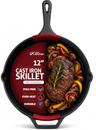
How we ranked twelve inches of iron
Fixing the diameter removes the variable every other skillet page argues about, and it exposes the four that are left. In order of how much each one changes the cooking:
1. The published flat floor, not the rim
“12-inch” is the measurement across the top of the pan. The part that touches food is the flat disc at the bottom, inside the curve where the wall begins, and it is always smaller. Where makers publish both figures, the gap is large:
- Lodge Classic 12-inch — a 9.12-inch flat bottom inside a 12.56-inch total width, published on Lodge’s own dimensional drawing. About 65 square inches of flat iron by our arithmetic, from a footprint of about 124.
- Stargazer 12-inch — a published 9.4-inch machined cooking surface, about 69 square inches. The biggest published floor here, and it arrives on one of the two lightest pans.
- Lodge 12-inch deep skillet — an 8.75-inch flat bottom, about 60 square inches. The extra wall height is bought partly with floor.
- Lodge 12-inch dual handle pan — the listing publishes overall dimensions of 14.56 x 12.63 x 2.24 in and 6.61 lb, and no floor figure, so that row on its card reads Not published.
Three of the pans here publish nothing at all for the floor. That is not a reason to avoid them — it is a reason not to believe anyone who quotes you a cooking-surface number for them, including us. Our cast iron skillet sizes guide lays the published figures for every size side by side.
2. Weight, which varies by 2.4x at one diameter
This is the most surprising thing about the category. At a fixed 12 inches the published weights run from 6.14 lb (Lodge Blacklock, cast deliberately thin) to 14.49 lb (Lodge’s covered deep skillet, which is a pan plus a roughly 5.2 lb iron lid by subtraction from Lodge’s own bare and covered spec pages). Between them sit the Stargazer at 6.5 lb, the dual-handle pan at 6.61 lb, the Utopia at 7.58 lb, the classic at 7.89 lb and the lidless deep skillet at 9.28 lb.
More iron is better for searing and worse for everything you have to lift. Heavy pans hold their temperature when cold food hits them, which is why our steak skillet ranking puts mass first; the exact inverse argument is laid out in best lightweight cast iron skillets. At 12 inches the choice is unusually clean, because Lodge sells you both answers in the same size and publishes the weight of each.
3. The handle, and how many there are
Eight pounds of pan on one short lever is the most common complaint about a 12-inch skillet, and there are three published answers to it. Lodge’s Blacklock has an “extended, raised handle” that Lodge says stays cooler longer. Lodge’s 12-inch dual handle pan deletes the lever entirely and gives you two loops instead, which is a two-mitt lift but a balanced one, and a shorter pan to store. And FINEX’s octagonal 12-inch winds its handle from 300-series stainless rod with a helper tab, so the handle sheds heat rather than storing it — we do not rank it here because FINEX and its listing publish two different weights for the same pan, and we will not print a figure we cannot stand behind.
A cheaper fix exists for a pan you already own: Lodge sells the same 12-inch classic bundled with its ASHH41 silicone handle holder, and the holder on its own is a few dollars. Our cast iron accessories page ranks the holders and scrapers.
4. Walls, and whether a lid comes with it
A standard 12-inch Lodge is about 2.25 inches tall. The deep version is 3.43 inches by Lodge’s published figure and holds 5 quarts, which is the difference between frying four chicken thighs and braising them. The covered version adds the iron lid in the box. If the lid is the reason you are here, read best cast iron deep skillets next — it ranks the depth question on its own terms, including the 10.25-inch versions and the combo cooker.
Twelve inches and your stove: the part to check first
GE publishes the clearest rule we have found for pan size on a radiant cooktop: “Your pans should not hang over more than one inch on each side of any surface burner. For example, on an 8″ burner the maximum pan size should not exceed 10″.” Its stated reason is that oversized pans trap heat between the pan and the cooktop and transfer a lot of it into the glass. GE also documents the temperature limiter under a radiant element, which cuts power to the element at roughly 880°F and is likelier to trip under a large pan.
In practice, on a domestic hob, a 12-inch iron pan has a hot middle and a noticeably cooler outer inch. You work with it rather than against it: preheat longer and lower than feels right — Lodge’s own guidance is three to five minutes on medium-low before cooking most things at medium-high — and treat the rim as a holding zone rather than a searing zone. Anyone promising you even heat across twelve inches of iron on one burner is describing a property iron does not have; poor conduction is the same property that makes it hold heat so well once it is up to temperature.
Three stove-specific pages carry the rest of this: cast iron on a glass top stove, on an induction cooktop (where the pan’s base should roughly match the ring rather than exceed it) and on an exposed-coil electric stove.
What a 12-inch pan is genuinely better at
Four chicken thighs with air between them. Two large steaks with room to get a crust rather than steam. A whole family’s worth of hash, sausages or fajita vegetables in one batch instead of two — and batching is where cast iron is at its weakest, because the pan drops temperature between rounds and the second batch is never the first. A 12-inch skillet also takes a bigger cornbread: diameter sets batter depth, which is why our cornbread ranking treats it as the primary criterion and uses Lodge’s own pan-by-pan bake table. What a 12-inch skillet will not do is bake a risen loaf, because an open pan traps no steam — best cast iron for bread ranks the lidded shapes that do.
What it is worse at: eggs, two portions, and anything you would rather flick with one wrist. A 12-inch pan is about 18 inches long with the handle, which is longer than a lot of domestic sinks will take flat under the tap, and it is a two-handed lift loaded and hot. If you have not owned cast iron before, a 10.25-inch is still the right first pan — see best 10-inch cast iron skillets — and the step up to twelve is a second pan, not a replacement.
What we left off, and why
Backcountry Iron’s Wasatch 12-inch is a machined smooth pan at roughly half heirloom money, and we rank it on best smooth cast iron skillets and on best large cast iron skillets. It is not a pick here because its own dimension table publishes 9 lb for the 12-inch where its Amazon listing publishes 5 lb — the maker’s figure for the eight-inch — and a page ranked on published weight cannot rank a pan whose published weight is in dispute.
Cuisinel’s 12-inch is the only budget brand here that puts terms in writing: a registered limited lifetime guarantee and a published oven ceiling of 480°F on its own FAQ. We think that ceiling is wrong for bare iron — there is nothing on a seasoned pan to fail at oven temperatures, which is why every Lodge row on this site reads Not published rather than a number — and we would rather send you to a pan whose maker does not publish a limit it cannot justify. The Cuisinel review lays that out in full.
Enameled 12-inch skillets are a different product with a different ceiling, and autocomplete asks for them on their own stem. They are ranked at best enameled cast iron skillets.
If you only buy one
Buy the Lodge Classic 12-inch. Nothing on this page cooks better for the money, and Lodge publishes more about it than anyone publishes about the cheaper pans. Spend less and the Utopia 12-inch is still iron, with the disclosure gap stated. Spend more only for a reason you can name: less weight (Blacklock), a machined floor (Stargazer) or a lid in the box (the covered deep skillet).